Unlock Festive Creativity: Christmas Tree Collage Backgrounds
When the holiday season approaches, the pressure to create unique, high-quality content skyrockets. Whether you are a scrapbooker looking to preserve family memories, a small business owner designing holiday packaging, or a graphic designer curating a festive mood board, the search for the right texture often dictates the success of the project. This is where a versatile set of Christmas Tree Collage Backgrounds becomes an indispensable part of your digital toolkit. These aren't just simple images of trees; they are intricate compositions designed to bring depth, nostalgia, and artistic flair to any surface they touch.
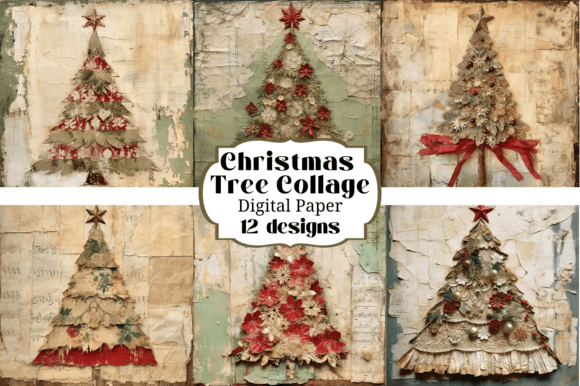
The visual personality of these backgrounds relies heavily on the concept of layering. Unlike a standard stock photo, a collage background implies a history—a tactile sense of paper, ink, and arrangement. These digital papers often feature overlapping silhouettes of pine branches, vintage ornament illustrations, and snippets of holiday script, all blended into a cohesive 300 DPI image. The aesthetic bridges the gap between rustic charm and modern graphic design, offering a "premium font" equivalent for visual backgrounds. It provides the complexity of a hand-crafted art journal page without requiring hours of messy gluing and cutting. For the busy creative professional, this balance of beauty and efficiency is the primary appeal.
The Anatomy of a Versatile Design Asset
Understanding the specific characteristics of these Christmas Tree Collage Backgrounds is key to utilizing them effectively. The files provided are high-resolution PNGs, which stands for Portable Network Graphics. In the world of digital design, this format is crucial because it supports transparency and lossless compression. This means that unlike a low-quality JPEG that might pixelate when printed, these files retain their crisp details even when scaled up for large format printing or cropped tightly for social media posts. The 300 DPI resolution ensures that the intricate details of the collage elements—whether they mimic watercolor washes, vintage paper scraps, or crisp digital illustrations—remain sharp and professional.
The visual style of these specific backgrounds tends to lean towards an eclectic mix. You might find one background that feels like a cozy, vintage scrapbook page with muted reds and sage greens, while another might feature bold, modern typography snippets layered over geometric tree shapes. This variety is intentional. It allows the creator to match the background not just to the holiday theme, but to a specific brand identity or aesthetic. For instance, a high-end boutique might choose a background with gold foil textures and elegant serif font overlays, whereas a children’s craft blog might opt for a brighter, more whimsical paper craft style. The lack of watermarks on the downloaded files is particularly important here, as it allows for clean integration into commercial designs without the need for heavy editing to remove branding artifacts.
Strategic Applications for Modern Creators
For the designer or entrepreneur, a digital asset is only as good as its return on investment. The true value of these Christmas Tree Collage Backgrounds lies in their cross-platform adaptability. In the realm of packaging design, these textures can transform a plain box into a gift-ready experience. Imagine a subscription box service wrapping their December selection in paper that features a subtle, repeating pattern of these collage elements. It immediately elevates the perceived value of the product, creating an unboxing moment that feels curated and thoughtful.
In the digital space, the applications are just as robust. Social media graphics need to stop the scroll, and a busy, textured background often outperforms a flat color block. These backgrounds serve as excellent foundations for Instagram stories, Pinterest pins, and Facebook headers. They provide enough visual interest to hold attention but are complex enough to allow white text to pop, improving readability. When pairing typography with these backgrounds, consider the hierarchy carefully. A bold display font for the headline can anchor the message, while a clean sans serif font for the body copy ensures the information is digestible against the textured backdrop.
- Scrapbooking and Junk Journaling: Use the backgrounds as the "base layer" for your pages. Because they are 300 DPI, you can print them on cardstock to create physical pages that look like you spent hours collaging.
- Blog and Web Design: Utilize these as hero images for December blog posts. They set a festive mood instantly and can be overlaid with a semi-transparent color block to make your web design text legible.
- Digital Planners: Create custom sticker sheets or dashboard covers for digital planners. The PNG format allows you to cut out specific tree elements to use as standalone stickers.
- Greeting Cards: Combine these backgrounds with elegant script fonts or handwritten fonts to create professional-grade Christmas cards that you can sell on platforms like Etsy.
Integrating Texture into Brand Identity
Brand consistency is often discussed in terms of logo usage and color codes, but texture plays a subtle, powerful role in brand perception. A brand that utilizes rich, tactile visuals—like these Christmas Tree Collage Backgrounds—communicates warmth, creativity, and attention to detail. This is particularly effective for service-based businesses during the holiday season. A photographer, for example, could use these backgrounds to create a "Holiday Mini-Sessions" flyer. The collage aesthetic mirrors the nostalgic, memory-keeping nature of photography, creating a thematic resonance between the medium and the message.
However, the integration of such complex backgrounds requires a disciplined approach to visual hierarchy. When the background is rich with detail, the foreground elements must be stark and simple. Avoid the temptation to use ornate serif fonts or busy script fonts directly on top of the busiest parts of the collage. Instead, use a solid shape—like a circle, rectangle, or banner—placed between the text and the background. This "buffer" zone ensures that your message remains the focal point. This technique is a staple in editorial design and magazine layout, where imagery is often dense and text needs to be superimposed without getting lost.
Furthermore, consider the color grading of the backgrounds. While the holiday season is synonymous with red and green, modern brand identity often favors palettes like "Winter Wonderland" (whites, silvers, icy blues) or "Rustic Charm" (browns, creams, forest greens). When selecting your background from the pack of 12, choose one that aligns with your existing brand palette. This ensures that your holiday marketing feels like a natural extension of your brand rather than a temporary departure. Using a creative font that matches the era of the collage elements (e.g., a retro font for a vintage collage) can further solidify this cohesive look.
Practical Workflow and Technical Tips
Working with a zip file containing multiple high-resolution images requires a bit of digital housekeeping. Once you download and extract the files, take a moment to organize them. Even though the files are named and labeled for ease of use, creating a specific folder for "Holiday Assets" within your design library will save you time in future years. Because these are design assets intended for commercial use, keeping track of your licenses and file sources is a best practice for any professional.
When it comes to resizing, the high DPI of these PNGs gives you significant flexibility. You can comfortably scale them down for web use without quality loss, but scaling up should be done cautiously. While 300 DPI is the standard for high-quality printing, blowing up a digital image to poster size requires checking the pixel dimensions. For standard scrapbook pages (12x12 inches) and letter-sized documents, these files are perfectly suited. For larger format printing, such as event backdrops, it is advisable to test a small section first to ensure the texture remains crisp.
Finally, do not be afraid to experiment with blending modes in software like Photoshop, Canva, or Procreate. These Christmas Tree Collage Backgrounds can be transformed entirely by changing their opacity or blending mode. Setting a background to "Multiply" can remove the white background elements, leaving only the ink and texture, which is perfect for layering over other colors. Setting it to "Overlay" can add a subtle festive grain to a solid color block. These techniques allow a single pack of 12 backgrounds to generate dozens of unique variations, maximizing the utility of your purchase and ensuring your holiday designs remain fresh and distinct.